Editor’s
Note: Captain Kathy Broughton of Kitty Wake Charters docked at Zeke’s Marina in
Orange Beach, Alabama, has been a charter-boat captain for the past 15 years
and has fished the back bays and the front beaches around Perdido Pass since
1975.
Question:
Kathy, what will you be catching in November, and where will you be catching
them?
Broughton:
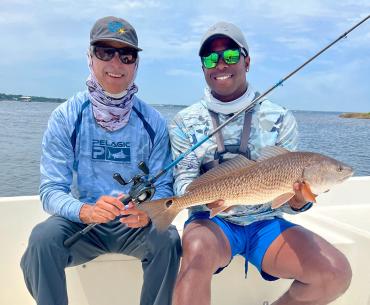
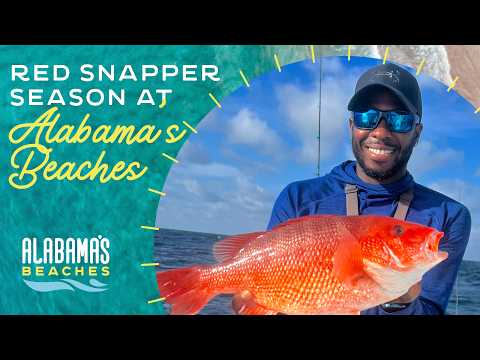
November is bull reds’ month in Orange Beach. These bull reds spawn just off
the beach from 100 yards to about 2- or 3-miles offshore. I prefer to fish for these
bull reds using live baits, such as pinfish, croakers, spots and alewives (if
they’re still available) on light spinning tackle with 12-pound-test line.
Question:
How big are the redfish you catch in November?
Broughton:
We catch redfish measuring from 24- to 44-inches long, weighing from 12 to 30
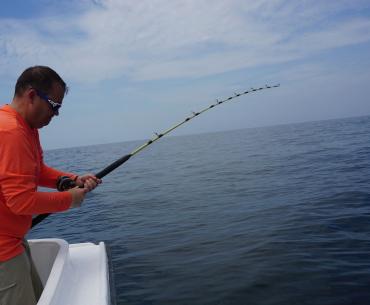
pounds. These big bull reds consistently bend our rods, stretch our lines and
cause our drags to scream.
Question:
How many reds will your customers hook in a day of fishing?
Broughton:
On a good day, my customers will hook six to eight redfish. On a great day,
we’ll hook 20 or 30 reds.
Question:
How long will fishing for bull reds last off Orange Beach?
Broughton:
Last year was one of the best years for bull reds we’ve ever seen on the Gulf
Coast with the fishing lasting from November until March. This year seems to be
just as productive for redfish as last year, and it may prove to be a better
year.
Question:
Why do you like catching big bull reds on light line?
Broughton:
Catching big reds on light line is more challenging than muscling the fish to
the boat using a big reel and 30-pound-test line. Anglers must use more finesse
and take more time landing a red using lighter line. Too, lighter line produces
a better fight from the bull reds. Since we release most November redfish because
of their big size, why not prolong our enjoyment and make the fight last as
long as possible?
Question:
What rod and reel do you use?
Broughton:
I’ll use Penn and Shimano’s Okuma reels with Contour Rods.
Question:
Tell me about speckled-trout fishing in November.
Broughton:
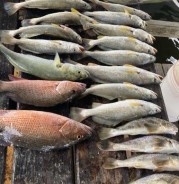
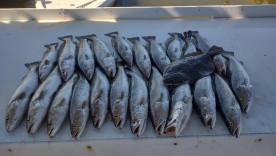
I fish the back bays and the jetties around Perdido Pass, the bridge at Perdido
Pass and the front beaches just out of the Pass. By November, most speckled
trout in these regions have left and moved north into the back bays. However,
good numbers of white trout will remain in coves and along the Intercoastal
Waterway. A few speckled trout should be in the canal as well. When the
speckled trout begin moving north in November, the flounder will start moving
south. We have a productive November flounder run on Alabama’s Gulf Coast. When
the speckled trout move north, the flounder leave the estuary regions and swim
into the Gulf’s back bays, jetties and the Pass. These flounder will hang
around in large numbers
until the first big cold front arrives, and then
they’ll move offshore. People interested in flounder fishing should stay close
to the Pass and fish the docks closest to the Pass.
A
new regulation has been introduced on flounder. In the past, no limits were
placed on flounder, but the new regulations state that anglers may keep only 10
flounder that are 10 inches or longer. I’m glad to see this limit placed on
flounder because flounder are fun to catch and delicious to eat, so we need to ensure
there are always plenty of them. My customers and I catch nice-sized flounder from
12- to 22-inches long in November, with 4 pounders not being uncommon. Too, large
numbers of mangrove snapper will be in this region during November, but these mangrove
snapper are usually less than 12-inches long, so we aren’t permitted to keep
them.
Question:
Kathy, what else do you catch along Alabama’s Gulf Coast in November?
Broughton:
If the weather stays warm, king mackerel and Spanish mackerel will roam the front
beach waters. The average-size November king mackerel weighs 4 to 5 pounds, but
10 pounders aren’t uncommon. A king mackerel weighing 3 to 5 pounds may have
brown spots and resemble a Spanish mackerel. To tell the difference between a
young king mackerel with brown spots and a very-large Spanish mackerel,
look at
the lateral line on the side of the fish. If this lateral line drops down to a
sharp 45-degree angle and then becomes wavy, you’ve landed a king mackerel. The
lateral line on the Spanish mackerel goes straight across the fish’s side and
is wavy but doesn’t have the sharp 45-degree drop. The daily creel limit on
king mackerel is two per person with a 24-inch minimum size limit, and the
limit on Spanish mackerel is 15 per person with no size limit.
Although
we catch a wide variety of fish in November, most fishermen visiting the
Alabama Gulf Coast look to battle with the big bull reds and catch white trout
and flounder to take home for supper. In November, even beginner anglers have
the opportunity to catch the bull reds of their lifetimes. You may catch four
or five monster bull reds on a day of fishing in November. So, y’all come on
down and fish with us, because we’ve got plenty of string-stretching action on
Alabama’s Gulf Coast this month.
To
fish with Captain Kathy Broughton, email kittywakecharters@yahoo.com, or
call 251-981-4082 or 251-747-7375.