Editor’s
Note: Clyde Brothers of Clyde’s Inshore Fishing, based at Bear Point Marina in
Orange Beach, Alabama, fishes primarily around Perdido Pass. In February,
anglers can expect to catch big bull reds, sheepshead and any other species of inshore
fish off Alabama’s beaches.
Question:
Clyde, what’s biting in February in the Gulf of Mexico, and where will you
catch them?
Brothers:
In February, our primary targets inshore are the big bull reds. We’ll find and catch
them trolling along the beach with deep-running crankbaits and jigs.
Question:
What crankbaits do you like to use when you’re trolling for big bull reds?
Brothers:
We prefer to use pink-colored Mann’s Stretch 25+ with 2- to 4-ounce lead-head
jigs and Screw-Tail Grubs on the back.
Question:
What pound-test line do you use for the big reds?
Brothers:
When I’m trolling, I use 20-pound-test line. When we locate schools of redfish,
I’ll cast to them with jigs on 12-pound-test line.
Question:
How do you find and catch redfish inshore off Alabama’s beaches in February?
Brothers:
I’ll troll in areas where I generally catch redfish, look for schools of
baitfish on the surface, and then troll to the outside edge of that school. If
we catch a redfish while we’re trolling, we’ll reel in the redfish, release it,
reel in our trolling tackle, pick-up our casting rods and then start casting to
the redfish under that school of baitfish.
Question:
How big are the redfish you’ll catch fishing along Alabama’s beaches?
Brothers:
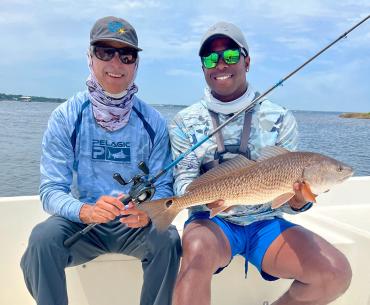
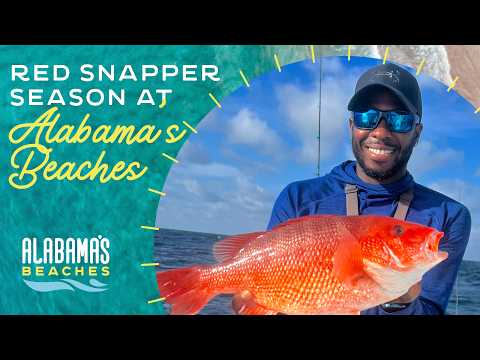
We’ll catch redfish 32-inches and larger. Our average redfish in February will
be 32- to 39-inches long, weighing 12- to 30-pounds each. Occasionally, we’ll
catch a bigger redfish.
Question:
How long do you fish for reds, and how many do you expect to catch?
Brothers:
On a 4-hour trip, we’ll catch one to two redfish on a bad day. On a good day,
we’ll catch as many as 20 redfish in 4 hours.
Question:
How long will the big reds run at the beach?
Brothers:
The redfish usually stay close to the beach, until the water warms up, and then
they move inshore where you’ll find the baitfish. The redfish come in to the
beach because they like to spawn at the mouth of Perdido Pass and the bow of
the bay. The mouth of Perdido Pass is one of our favorite places to fish.
Question:
The redfish is your primary target this month, right?
Brothers:
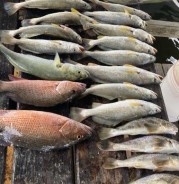
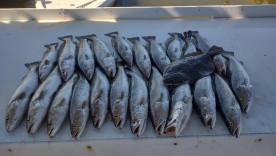
That’s right. We’ll also start to see sheepshead inshore in February. If you
run-up into the creeks that feed into the bay, you still can catch speckled
trout this month, too.
Question:
Where do the sheepshead show up in February?
Brothers:
Perdido Pass has a good jetty system, a really-nice bridge and other structures
that carry barnacles. The sheepshead come to the rocks and the bridge pilings
to feed on the barnacles. Although February is too early to see numbers of
sheepshead, we’ll see a few toward the end of the month with their numbers
increasing as March approaches. Inshore fishing for speckled trout picks-up
around the end of March. During the first of March, pompano, one of the finest
eating fish in the Gulf Coast, begin to show up, and we start catching them.
Question:
What species do you primarily target inshore at Alabama’s Coast in February?
Brothers:
I target any species that’s biting. My job is to help my customers catch fish.
We fish productive spots in February, using baits, such as live shrimp, that
will produce the most fish for my customers every day we
fish. There are
very-few fish in the Gulf of Mexico that won’t eat live shrimp. We hook the
fish just under the horn and Carolina-rig them with an egg sinker up the line,
a barrel swivel below the egg sinker and about 2 feet of leader going off the
barrel swivel to the hook. We’ll use 12-pound-test main line with a
20-pound-test leader and a No. 1/0 hook. Rigged this way, you can catch almost
any fish that swims in the bay, under the bridge, along the jetties or out in
the Gulf.
To
book a trip with Clyde Brothers at Clyde’s Inshore Fishing, call him at
251-752-0421, or visit www.clydesinshorefishing.com.